
The Marketing Funnel in 2023
Has the Fun gone out of the Funnel?
Summary:
Ever since its invention in 1898, the marketing funnel (also known as sales funnel, conversion funnel or purchasing funnel) has been used, discussed, applied and reinvented constantly. Is the marketing funnel still relevant in the context of a person making a purchase in 2023? What is the difference between the overarching marketing funnel framework and the pre-built “funnel solutions” advertised all over the internet in the recent years? Clearly, in today’s ever evolving cross-channel, multi-touchpoint, hypercompetitive and ultra demanding purchasing journey a locked-in funnel mindset comes across as limited. Why is that and what are some alternative frameworks that companies should migrate towards? Last but not least, how and where to start with adopting a new business framework?

What happens to your funnel when you stop “pouring” at the top?
What is a Marketing Funnel?
Developed in 1989 by American advertising advocate E. St. Elmo Lewis, the marketing funnel is a theoretical sequence of steps that people take before making a purchase. Surely you've heard of AIDA before? Stands for Attention, Interest, Desire and Action, the standard stages of the classical marketing funnel framework. Illustrating the purchasing process as a funnel that starts wide, and slims down with its every next stage, this framework makes for an easy way to visualize and understand the buying journey by virtually anyone, marketer or not.
What are the stages of a Marketing Funnel?
Since its introduction, the marketing funnel has evolved and gained multiple versions and interpretations. We take just a few examples below:
-
Attention - Interest - Desire - Action
Probably the most classical framework, assuming that companies need to first catch the Attention of their potential customers. As that is secured, job to be done is to have a plan on how to raise the Interest around its offering and plant the seeds of Desire. Final step is to determine the potential customer to take Action and turn into a buyer.
-
Similar to AIDA, this is a shorter version that groups raising interest and creating a need together with the challenge of staying top of mind as the potential client is researching alternative offerings before making a purchase.
-
> Top of the Funnel > Middle of the Funnel > Bottom of the Funnel
A funnel framework that shifts from the customer and its journey, putting the focus on the processes and tactical plans of the company trying to attract clients. More concretely, this model starts at the top with generating traffic and leads and proceeds with nurturing the leads collected towards transforming them into paying customers. Marketing and Sales teams are working together but with a slightly different focus, the first feeding the top of the funnel while the latter taking the lead on nurturing and converting the prospects into paying clients.
-
A marketing funnel alternative developed by Avinash Kaushik while in his role at Google.
AIDA is not walking the talk of customer centricity is what Avinash felt so he developed this framework to put the customer first, to bring measurement into the same picture while also re-aligning the understanding of successes. The See-Think-Do-Care business framework splits the audience into intent clusters and outlines how to serve each of them.
What about the pre-built lead generation funnel solutions?
Off-the-shelf funnels are advertised all over the internet nowadays and we want to take the opportunity to clarify the difference between the marketing funnel concept, which is the strategic marketing framework, and the ready to buy pre-built funnels. These are actual examples of a funnel technical implementation and are generally built for lead generation driven industries.
Are these locked-in funnel solutions worth the investment? Do they get you clients on demand and sky-high conversion rates as per the over confident advertisement? We cannot answer from experience - yes, we have been in the industry for 10+ years and never worked with such solutions. We first built “in-house” funnels, using the intelligence acquired around the existing customers and saw them evolve into simple, and then more and more complex customer journeys. The lure of getting a ready made one is strong and clear, for small business owners especially. The magical results promised … might raise some eyebrows here and there.
Why is the marketing funnel framework limited in 2023?
Regardless, holding on to a funnel path too tightly, especially in today’s ever evolving cross-channel, multi-touchpoint, hypercompetitive and ultra demanding purchasing journey can be very limiting and alienating. Here are just some of the real-life aspects that companies miss out on, when they think and plan rigorously “inside the funnel”.
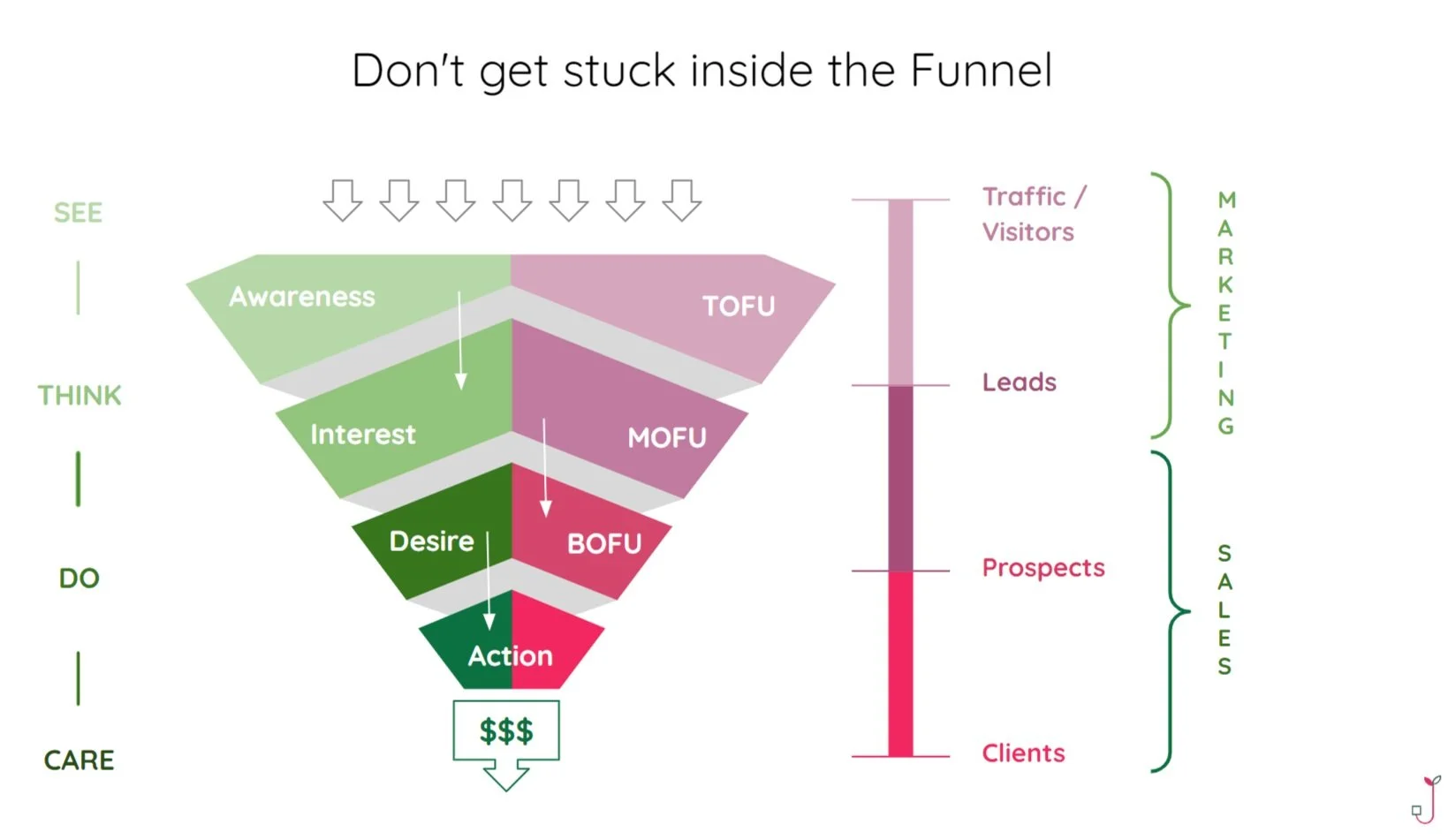
It’s 2023. Think outside the Funnel.
1. The Marketing funnel demands to be constantly “fed” and leaves little room for everything else
Consistent and perpetual effort is put into running marketing activities aimed at driving exposure, traffic and leads at the top of the funnel. When the aforementioned initiatives stop, sooner rather than later, the funnel will dry out and there will be no new clients coming out at the other end. Here are 2 important, real-life aspects that the view from inside the funnel is missing out on:
(a) some people will take longer to become a client. A very strict funnel approach will “lose” or discard them along the way as they stop progressing down the funnel according to the set timeline.
(b) neglecting your existing clients is a major mistake. A restless chase to feed the funnel and get new clients tends to result in taking existing clients for granted. Happy clients are the most sure and cost efficient way of getting new clients.

Is your marketing funnel always hungry for more leads?
2. The Marketing funnel assumes that the act of buying follows a unidirectional and linear sequence of steps
Welcome! Please circulate top to bottom following the signs and timing indicated along the way. Applying the funnel framework to the letter, focuses on getting people in the fabulously designed funnel and pushing them down, step by step, towards the other end. And if this doesn't sound a little coercive already, something else to remember is that people get distracted, easily.
Except for maybe ordering pizza for lunch, there is probably no other buying decision that follows a linear journey. People today will jump in and out of the routes to purchase drawn by companies and they will create new ones with every occasion. We can say with 100% certainty that user journeys are more complex today then they ever been and even visualizing them as linear is a big miscalculation, imagine planning marketing activities like this.
So, what is are the alternative frameworks to the Marketing Funnel?
The inverted funnel, putting all the focus on the existing customers and letting them do the “work” of growing the business is surely fun. However getting those first clients in and making them happy requires some sort of client acquisition process before the flip.
Another framework replaces the good old funnel with another metaphor - the flywheel. A model that does not demand to be constantly replenished up at the top, but rather envisions gaining momentum to spin, partially in a self sustained way, by building on the small wins that a business accumulates over time.
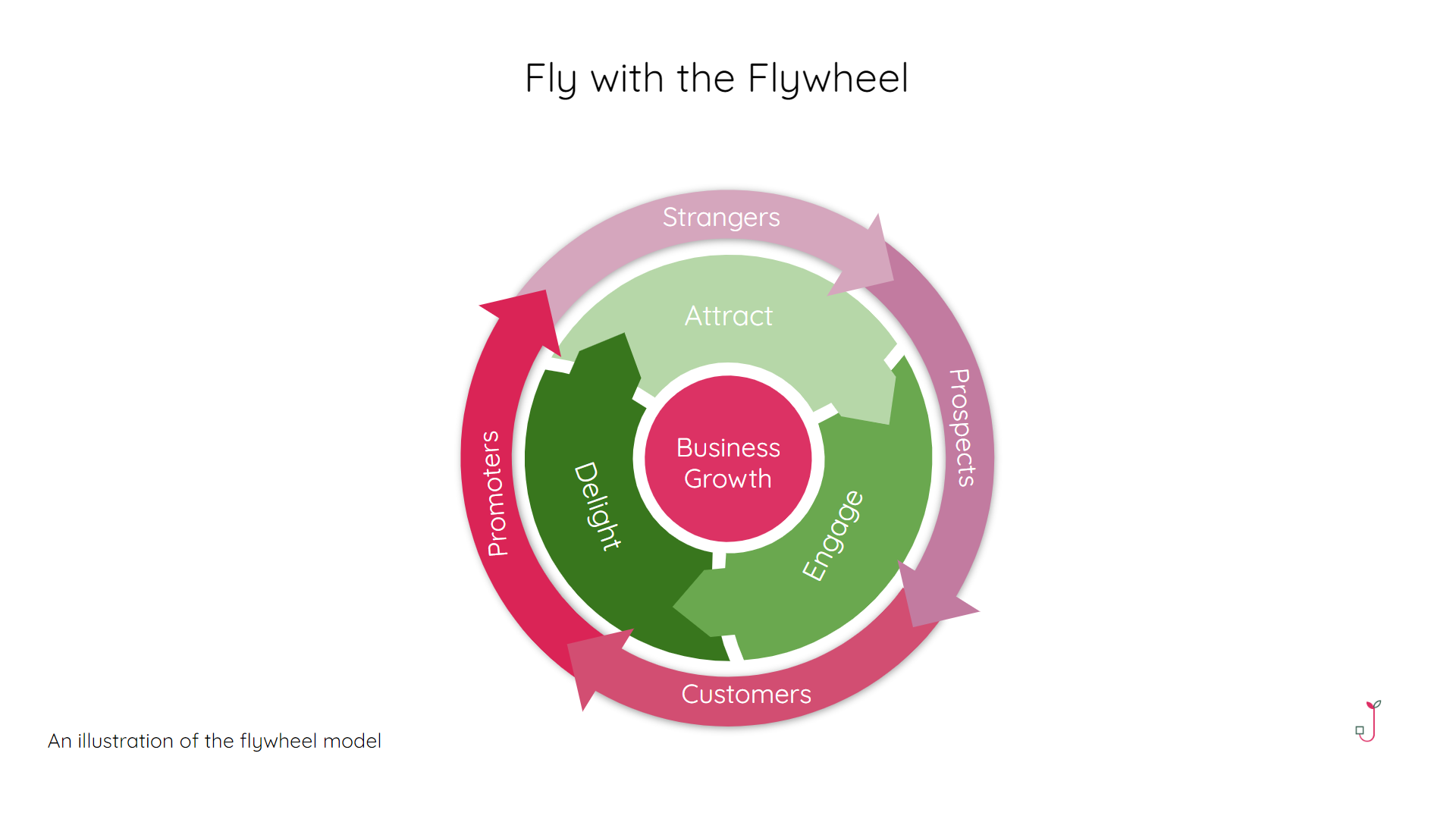
The Flywheel model is based on a concept by Jim Collins (“Good to Great” book)
The flywheel shifts focus from the company processes back to the customer and it replaces the one-way direction of the funnel with a circular movement. Let’s look closer to the evolution that the flywheel brings versus the funnel and at what makes it more relevant for today’s marketing and sales planning.
1. The flywheel brings and requires a powerful mindset shift
“Using a flywheel to describe our business allows me to focus on how we capture, store and release our own energy, as measured in traffic and leads, free sign-ups, new customers, and the enthusiasm of existing customers. It’s got a sense of leverage and momentum. The metaphor also accounts for loss of energy, where lost users and customers work against our momentum and slow our growth.” says Brian Halligan (co-founder and CEO of HubSpot) in a Harvard Business Review article about replacing the funnel with the flywheel.
2. Existing clients are the driving force of the flywheel
It is virtually impossible to make the mistake of losing sight of the existing clients and their priorities when using this framework. As a difference to the funnel, the happy end doesn’t come with getting a new client but rather when an existing client is happy, when it becomes a returning client and/or when it refers new clients. Imagine how the positive outcome at the bottom of the funnel turns back up at the top on its own, to generate new business. This is exactly how the funnel turns into a wheel with a self-sustained loop.
3. Unhappy clients and dissatisfactory brand engagement create friction
… and we cannot have that as it makes the wheel stop turning. Lost leads and prospects and especially unhappy clients are no longer seen as natural dropouts particularly when the volume is high or growing. Too many low quality leads? High or growing churn rate? The flywheel framework forces businesses to look into understanding the source and fixing the cause because it creates the undesired friction that can stop the wheel from turning. A funnel approach might lead companies to focus on replacing the lost clients with more new clients instead.
4. Internal misalignment creates friction … and friction is a no-no!
The internal silos: brand, marketing, lead generation and sales are blown up because the flywheel implies a whole new level of internal conversation and alignment. This frameworks does a much better job at pulling the entire organization behind the same shared objectives and that improves naturally the collaboration among teams (in the case of bigger organization, of course).
5. Flexibility wins over rigidly designed buying journeys no matter how well orchestrated and embellished they are.
The flywheel concept urges companies to meet the customers where they are. This alone makes for a higher chance to deliver what is expected at the other end. “Understanding where customers are, how they navigate streams in your market, and how to interact with them in a given stream is now central to crafting a good customer experience.” (Harvard Business Review, Sales Teams Need to Stop Focusing on the Customer Funnel, by Frank V. Cespedes, March 2023).
One of the companies who adopted and adapted the Flywheel model is HubSpot and they have several resources detailing the methodology and benefits should you wish to go into more details.
Where do you start with shifting your business towards the flywheel model?
At walking the talk of putting customers at the center of your business. Here is how:
1. Start every day with thinking about how you can get better at serving your customers. Focus on delighting your existing customers before throwing yourself into the chase of finding new clients and making more sales.
2. Aim to establish a meaningful first-contact and to build a relationship instead of pushing your commercial agenda. Always meet the customers where they are.
3. Measure the experience, not only the sales. Keep the conversation going and always facilitate and encourage feedback. Start with planning a quarterly/annual customer satisfaction survey to bring a little bit of structure into the process but also ask your clients directly every time you get the chance to speak to them.
4. Know what makes your flywheel spin faster and allocate resources there. Making and keeping existing clients happy is must. Next on the list: look closely at your own business context and spot the areas where you excel. Is it a specific subset of your audience? Is it a specific product or service? Is there a certain aspect of your business story that makes people “click” with you?
5. Know what creates friction and slows down your business wheel - search, identify and work on removing friction along the experience provided. Hear people out when they complain - it is the best way to improve your business.
6. As your company grows, put all your teams behind the same objective. The funnel approach tends to unintentionally separate marketing from sales. Having despaired objectives across teams makes for one big internal friction on your business wheel.
So, it seems that indeed the fun has gone out of the funnel. The bigger picture - the customer’s end-to-end journey, is today too complex to fit inside the linearity and flatness of a funnel. Companies should simply really start thinking more like their customers do. Ready? Start with point number 1 on the list here above!
Image credits (in order): Karl Fredrickson (via unsplash), Journee Gmbh, Ricardo Gomez Angel (via unsplash), Journee GmbH.
References and research for this article:
Harvard Business Review, “Sales Teams Need to Stop Focusing on the Customer Funnel” by Frank V. Cespedes
“See, Think, Do, Care Winning Combo: Content +Marketing +Measurement!” by Avinash Kaushik
Hubspot, “The Flywheel Model”
Harvard Business Review, “Replacing the Sales Funnel with the Sales Flywheel” by Brian Halligan
McKinsey & Company, “From touchpoints to journeys: Seeing the world as customers do” by Nicolas Maechler, Kevin Neher, Robert Park

About Journee - Digital at Ease
Founded by two digital marketing professionals with extensive international experience, Journee GmbH is a female owned digital marketing and technology boutique consultancy.
We aim to make a big difference for the small: small business owners and solopreneurs looking to start and advance on their business digital journey.
Our combined expertise covers digital marketing, digital analytics, advertising, marketing technology as well as overall digital strategy support and mentorship.